Nobody Finds A Business Park By Accident.
Maryland Heights runs on business parks. Westport, the offices and flex space along Dorsett, the corridors feeding I-270 and Page — a lot of St. Louis County's working businesses sit behind a driveway rather than on a street, which makes the sign out front the only thing telling anybody they exist. Our prepared DIY LED sign kits ship to every one of those addresses with the LEDs already mounted inside the frame.
St. Louis sign quotes are not cheap, and they get worse once install labor and equipment are in the number. We weld the aluminum cabinet to your size, ship it in sections, and hand you the install — which is where up to 60% depending on your project comes from.
The Lighted Sign Cabinet, And The Price Difference
Shipping To Maryland Heights And Every Town Around It
Kits ship to Bridgeton, Creve Coeur, Earth City, St. Ann, Overland, Hazelwood, Chesterfield and Town and Country — and everywhere in between. If FedEx delivers there, your sign kit can too.
An office or flex address does not have a storefront doing the advertising for it. What you have is a driveway entrance, a monument out by the road and maybe a slot on a shared tenant panel. Lit, at the right size, that sign is the whole difference between customers finding the driveway and driving past it twice. Multi-tenant properties usually carry landlord sign criteria on top of the city code, so get both answers, get the approved size in writing, and we weld the cabinet to it.
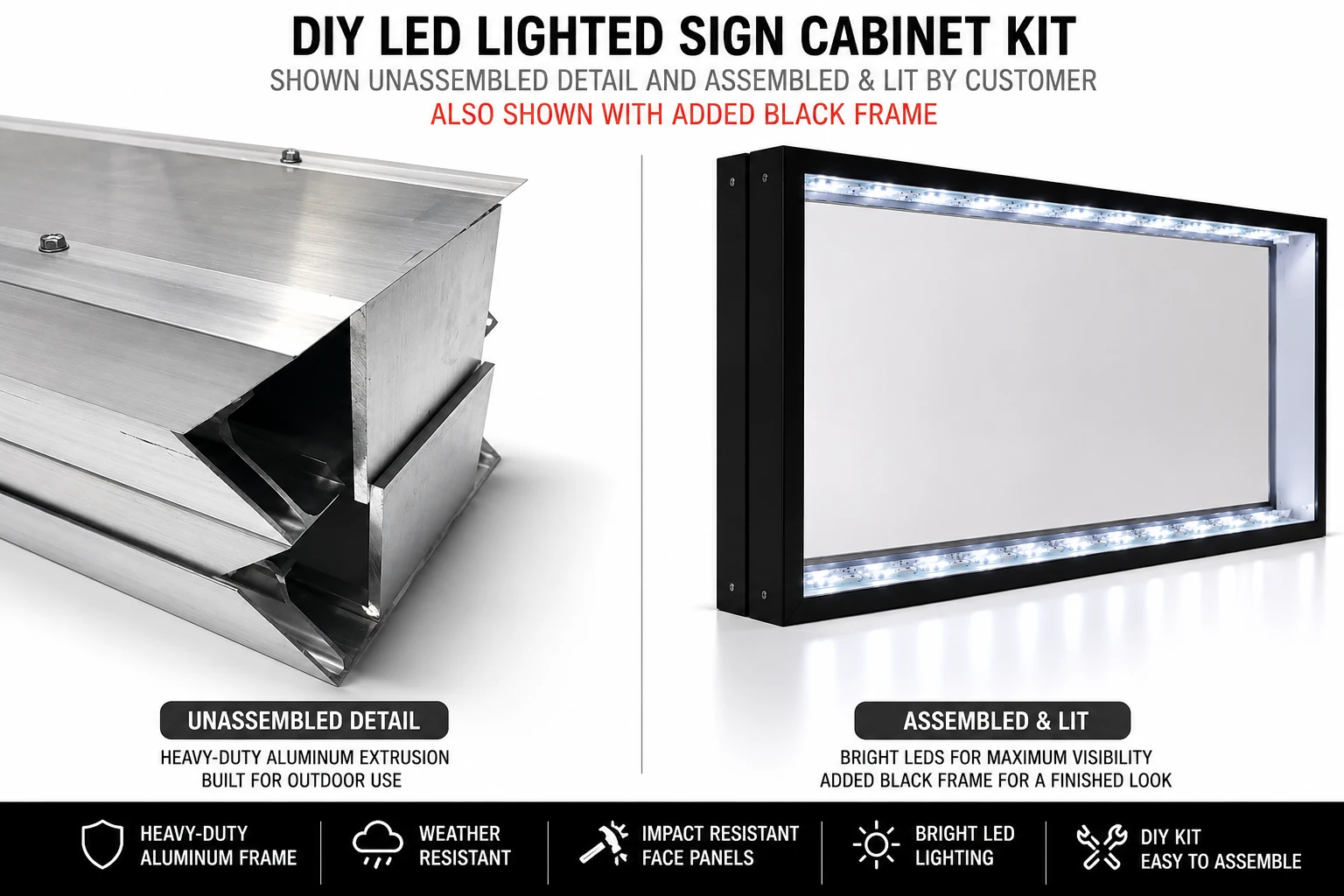
Call it what you like — an illuminated cabinet sign, a light box sign, or an outdoor lighted sign box — it’s the same product: an aluminum LED sign cabinet, built in our shop and shipped to your door as a ready-to-assemble kit.
Every prepared kit includes: an aluminum frame cut to your size with welded corners, LEDs mounted inside, and a 12-volt power supply with wiring hardware as listed in your written quote. Sign faces and graphics are available separately through DIY Graphics.
Programmable LED Message Center Signs
A lot of Maryland Heights owners shopping for a lighted sign are really after the changeable kind — a programmable LED sign that shows something different tomorrow than it does today. That product goes by a pile of different names: an electronic message center (EMC), an LED message board, an outdoor LED display, a scrolling LED sign or a digital marquee sign. They all describe the same thing — a grid of LEDs you update yourself from a phone, tablet or computer.
The usual setup on a Maryland Heights storefront or roadside pole is both signs together: the lighted cabinet up top carrying your business name permanently, and the message center below it carrying today’s special, price, hours or announcement. One says who you are. The other says what is happening right now.
Check this before you order. Many towns around Maryland Heights regulate electronic message centers separately from static signs, and limits on brightness, hold time, dwell time and animation are common. Confirm the rules with your local township or zoning office first — the same as you would for any freestanding sign. Easy financing available; ask about it when you request your written quote.
How Your Kit Gets To Maryland Heights
This is one of the most heavily served shipping corridors in Missouri — I-270, Page and the Earth City side move packages all day long. You do not need to touch the freight half of any of that. Roughly 95% of our kits go FedEx Ground, so the boxes come to your suite door on the same route that already delivers to the rest of the building.
What shows up. Four long boxes carry a standard cabinet. Six carry the bigger ones, split at splice joints so no single package outgrows ground shipping limits. Every section arrives welded to your dimensions with the LED modules already fitted inside, and the power supply and mounting hardware are boxed in with them. That means one delivery and one thing to sign for, not a frame now and a crate of parts sometime later.
Delivery day. Plenty of buildings around here have a shared dock and a receiving policy you would rather not deal with. Skip it. There is no pallet, no liftgate and no delivery window to sit through — the boxes come to the door like any other package, and one person can move them into the suite without borrowing a forklift or filing anything with property management.
Open the boxes the day they land. Look the sections over even if the cartons look perfect, and do it before install day rather than the morning of. Photograph anything crushed, torn or bent and keep the packaging exactly as it arrived — that is what a carrier claim is built on. Finding a problem the day a box shows up is a phone call; finding it with a crew standing on a ladder is a lost day.
Where to put it. St. Louis County weather is a two-sided problem: August humidity that sits on everything, and January stretches where the salt trucks run for a week straight. Aluminum shrugs at both and it does not rust. The LEDs and the power supply are the sensitive part, and they ride in the same boxes as the frame, so keep the delivery indoors and out of a damp garage until install day.
Measure Twice. Order Once.
Your kit is cut to a size, welded, and pre-lit before it ships, so the size has to be right the first time. In Maryland Heights that means three phone calls before you order, not after.
1. Ask what you're allowed
Start with the City of Maryland Heights building or zoning department. The thing to know about St. Louis County is that it is carved into dozens of separate municipalities, each with its own sign code, so an address a mile down the road can answer to an entirely different city hall. Confirm which one owns your parcel before you take anybody's word for the rules. Ask for the maximum sign area and height for your zoning district, whether your sign counts as wall-mounted or freestanding, and what setback applies. Sign area is usually tied to your building frontage, so the answer is specific to your address — not to the block or to the business next door.
2. Ask your landlord
If you're in a plaza or center, the landlord's sign criteria sit on top of the city code and are often stricter. Cabinet depth, face color, letter height and mounting method are all commonly spelled out. Get the criteria sheet in writing before you pick a size — it is cheaper than rebuilding a cabinet that the center won't approve.
3. Ask about engineering and wiring
Requirements here get set locally rather than by one statewide standard, and the city will tell you what applies to your sign type. A pole or monument sign commonly needs a footing design and stamped structural drawings before review moves at all. Illuminated cabinets generally pull a separate electrical permit, and if your lot fronts a state route, ask whether anyone above the city has a say too. Plan on a licensed electrician for the final hookup and inspection either way. We build the cabinet; the permit, the footing, the disconnect and the sign-off are local work done by local people.
DIY Kit vs. Hiring A Maryland Heights Sign Company
The short answer: a full-service sign company sells a finished project — survey, fabrication, installation — and prices it that way. We are not a Maryland Heights sign installation company. We build the lighted sign cabinet itself, ship it to your door, and coach you while you or your contractor handle the install. That one difference is where the savings come from.
| What happens | Full-Service Sign Company | DIY Sign Guy Kit |
|---|---|---|
| Who builds the cabinet | They do | We do — cut to your size, LEDs mounted inside |
| Who installs it | Their crew | You, or a local contractor you hire |
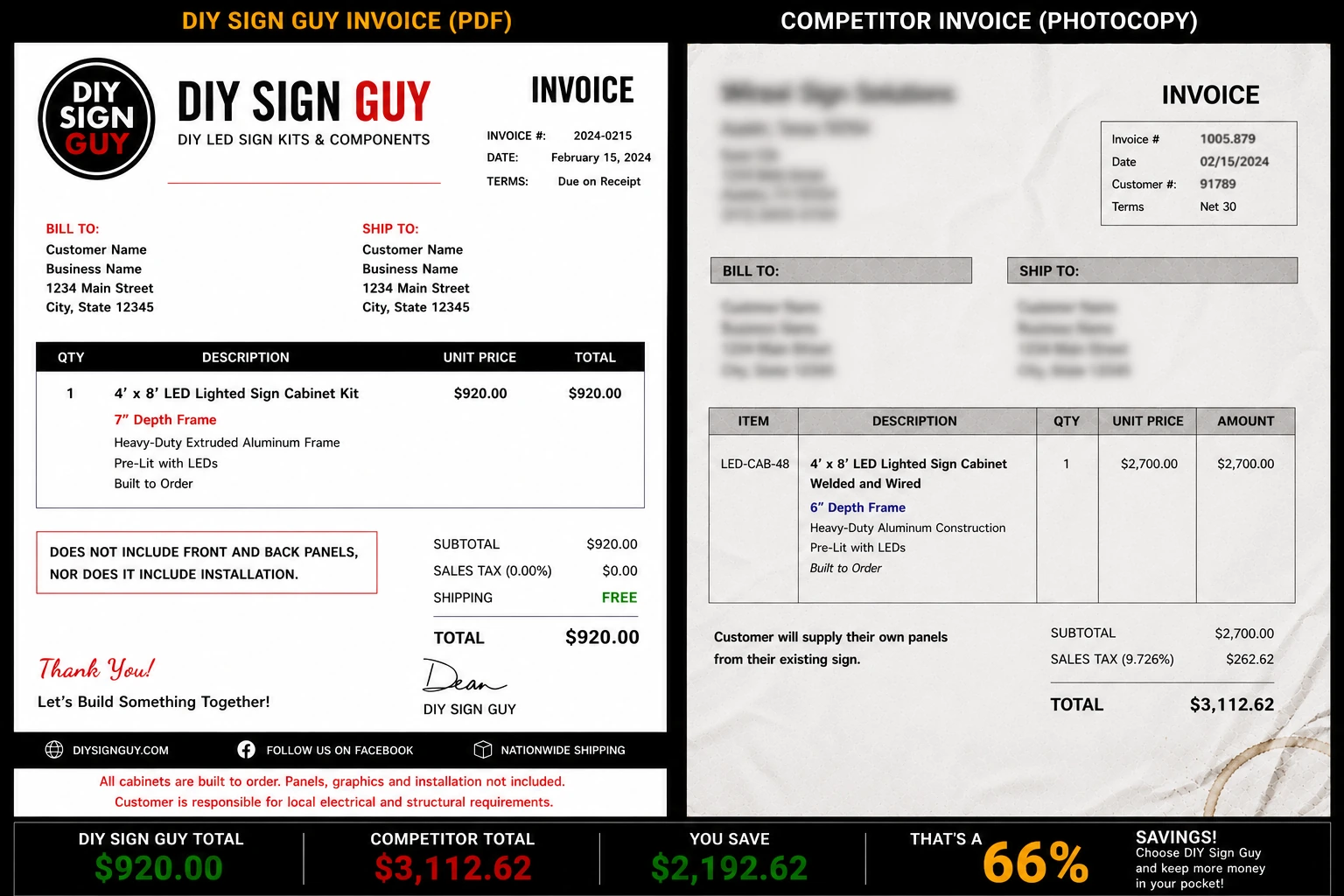
| 4′ × 8′ lighted sign example* | $3,112 | $984 kit + your installation |
| Permits & inspections | Usually handled for you | You check with your township — we help plan a cabinet that fits the rules |
| Best fit | Complex installs, no time to coordinate | Owners and contractors comfortable with bolts, a level, and an electrician for hookup |
* Example comparison based on the specifications shown on our pricing page. Savings are potential, not guaranteed; prices subject to change.
Lighted business sign kit pricing shipped to Maryland Heights
| Frame depth | Price per foot of frame length | Typical use |
|---|---|---|
| 4-inch — most popular | $41 per foot | Wall-mounted storefront signs |
| 7-inch | $47 per foot | Wall installs and double-pole signs |
| 10-inch | $67 per foot | Pylon and single-pole roadside signs |
Every kit is pre-lit with a 12-volt power supply included as quoted. Sign faces and graphics are separate. Prices subject to change without notice — get your written quote.
Straight Answers For Maryland Heights Businesses
We are one tenant of several. How does that work?
Common here, and the landlord usually matters more than people expect. Multi-tenant properties often issue written sign criteria covering panel size, cabinet depth, mounting method and sometimes color, and those criteria run alongside the city code rather than instead of it. Send the criteria sheet with your quote request and we build the cabinet to those numbers the first time.
Can one kit be seen from both directions?
The same frame supports single-sided or double-sided, so it comes down to how traffic reaches you. A cabinet flat against a building only needs one face. A monument set perpendicular to a road like Dorsett, where cars come at it from both ends, usually earns the second. Tell us which when you ask for the quote and it gets priced that way.
Do I need a permit for a lighted sign in Maryland Heights?
Assume yes, and confirm which city you are actually in first — St. Louis County has enough municipalities that people get this wrong regularly. Sign permits are generally handled by the City of Maryland Heights for addresses inside its limits, and an illuminated sign commonly needs a separate electrical permit as well. Nail down the approved dimensions in writing before ordering, since the cabinet is welded to one size.
Who should do the electrical hookup?
Hire a licensed electrician for the connection and keep the rest for yourself. Assembly, mounting and faces are straightforward work. The power side is not — it is licensed, it is inspected, and these kits are not UL listed, so an electrician has to make the final hookup. Book one while the kit is being built so nobody ends up waiting on anybody.
How much does a lighted business sign cost in Maryland Heights?
Less than most owners expect — because you skip the full-service labor. Our aluminum LED sign cabinet kits run $41 per foot of frame length in the 4-inch depth, $47 for 7-inch and $67 for 10-inch, pre-lit with the power supply included as quoted. As an example comparison, a 4' x 8' lighted sign quoted at $3,112 by a full-service company runs about $984 as a kit — savings are potential, not guaranteed. Sign faces and graphics are separate, prices are subject to change, and every kit is quoted in writing to your exact size.
Do you install signs in Maryland Heights?
No — we are not a Maryland Heights sign installation company, and that is exactly why the price works. We build and ship the lighted cabinet; you or a local contractor handle the mounting, with a qualified electrician for the electrical hookup. Real guidance from the builder comes with every kit, and your local township sets the permit and inspection rules.
Do you sell programmable LED message center signs in Maryland Heights?
Yes. An LED message center — also called an electronic message center, an EMC, a programmable LED sign, an LED message board or a digital marquee — is an outdoor display built into a sign that you change yourself from a phone, tablet or computer. It ships to Maryland Heights the same way our lighted cabinets do, and it is quoted in writing to your size. Many towns regulate message centers separately from static signs, so confirm brightness, hold time and animation rules with your local township before ordering. Easy financing available — ask when you request your quote.
What is the difference between a lighted cabinet sign and an LED message center?
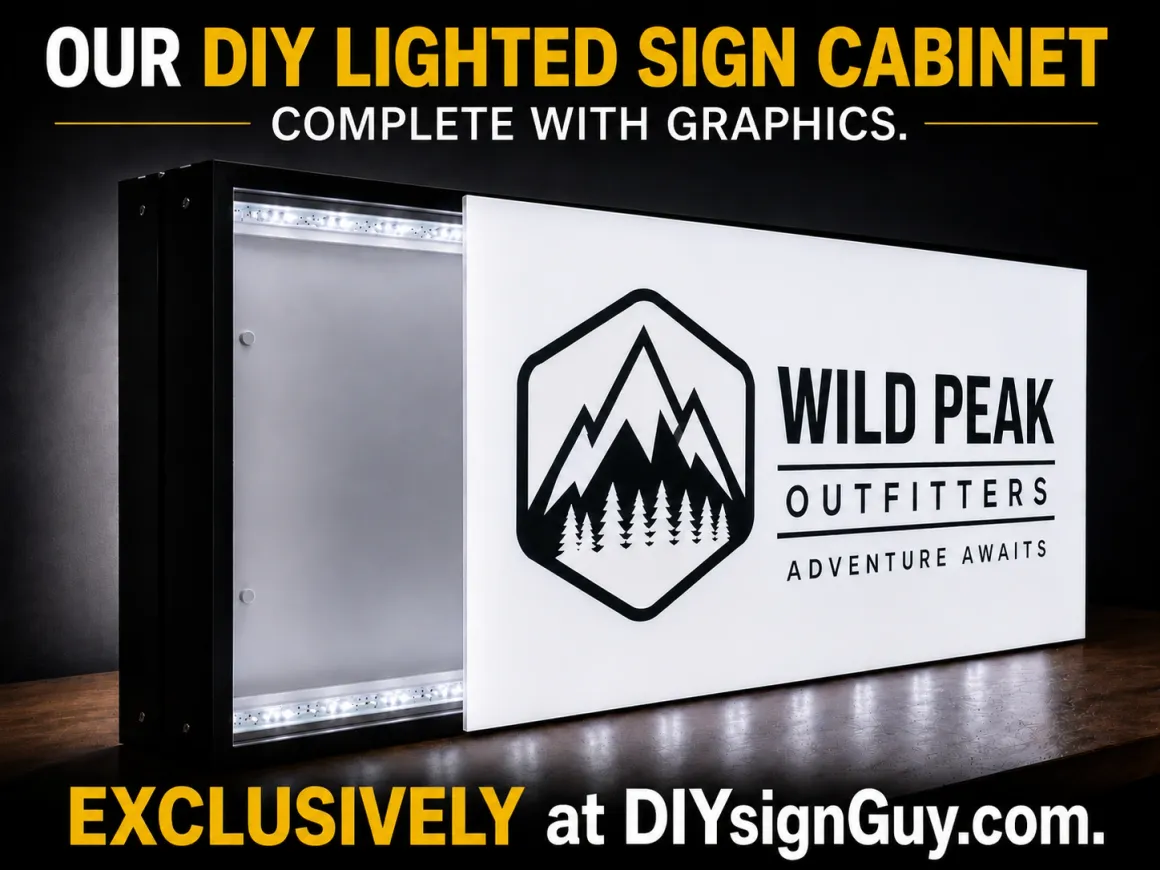
A lighted cabinet sign shows one fixed printed face and lights it from behind — it carries your business name permanently. An LED message center shows changeable messages you update whenever you want. Most businesses run both on the same structure: the cabinet on top for the name and logo, the message center below it for today's special, price or hours.
What is an illuminated cabinet sign?
An illuminated cabinet sign — also called a light box sign — is an aluminum box with lighting inside and translucent faces: the classic lighted sign above a storefront. Ours ships as a prepared kit with the frame cut to your exact size, LEDs already mounted inside, and a 12-volt power supply included as quoted.
Answers by Dean, the DIY Sign Guy — building signs since 2004.
Get A Written Price For Maryland Heights, MO
Tell me what you need and I’ll send you a straight, written quote — from the guy who actually builds it. No showroom visit, no pressure.