
Three Counties. One City Hall.
Aurora runs across three counties. Most of the city sits in Arapahoe, a large piece is in Adams, and the southern edge reaches into Douglas — which means two shops on the same road can have different county paperwork behind them. Our prepared DIY LED sign kits ship to every part of it, from Havana Street to the Southlands side, with the LEDs already mounted inside the frame.
A sign company quote covers welding, wiring, a crew and a boom truck. We sell you the first two and let you handle the rest. The aluminum cabinet is welded to your size, the LEDs go in before it ships, and the savings that used to go to labor stay with you — up to 60% depending on your project.
The Lighted Sign Cabinet, And The Price Difference
Shipping To Aurora And Every Town Around It
Kits ship to Centennial, Greenwood Village, Parker, Lone Tree, Commerce City, Englewood, Watkins and Denver — and everywhere in between. If FedEx delivers there, your sign kit can too.
Aurora is one of Colorado's biggest cities and it spreads across three county lines, which trips people up constantly. The city is home rule, so a sign inside Aurora limits generally goes through Aurora no matter which county sends your tax bill. The county still shows up in records, in addressing, and in anything the city does not administer itself. Sort out which jurisdiction actually reviews your sign before you order, and get the approved size in writing, because the cabinet is welded to that number and nothing else.
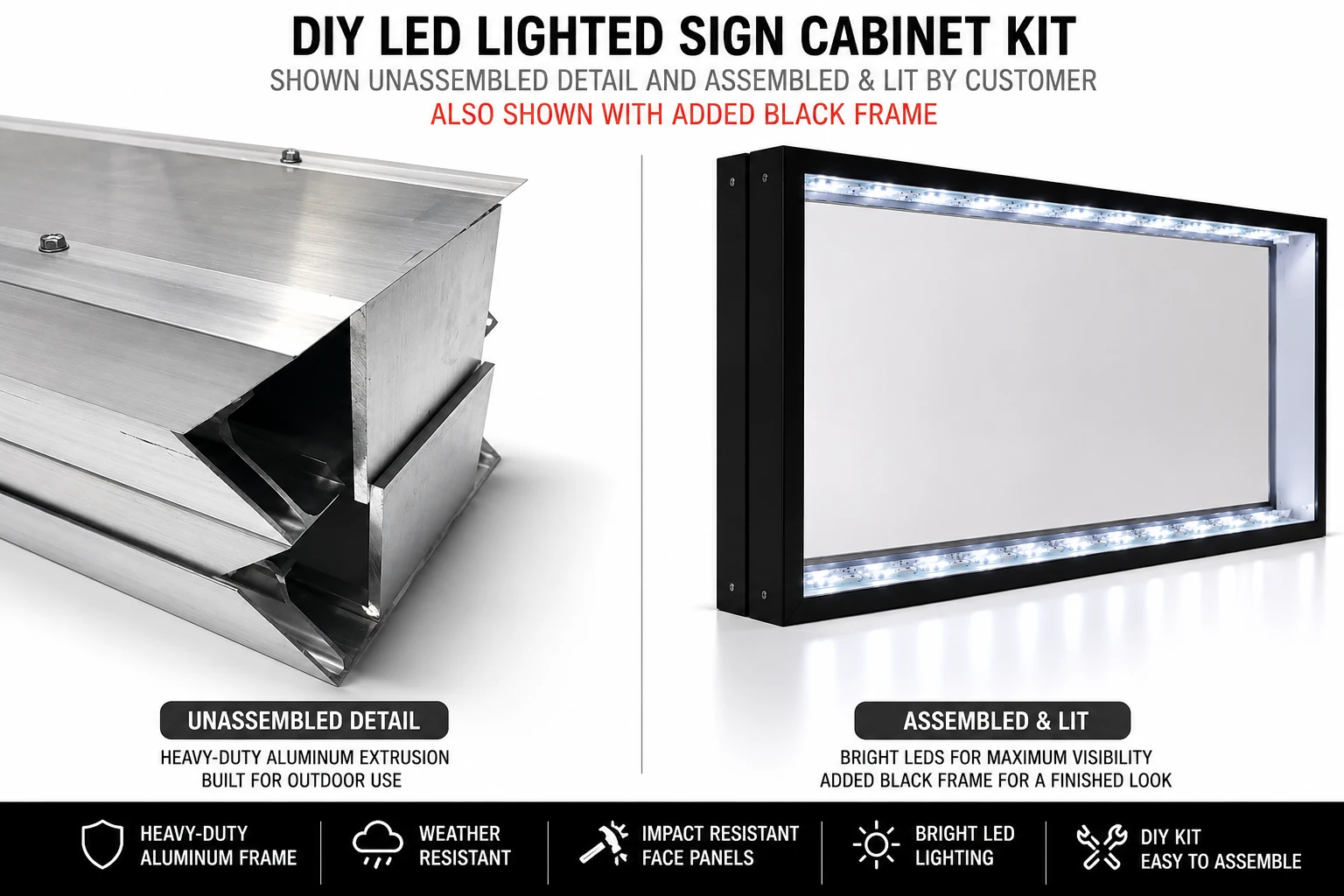
Call it what you like — an illuminated cabinet sign, a light box sign, or an outdoor lighted sign box — it’s the same product: an aluminum LED sign cabinet, built in our shop and shipped to your door as a ready-to-assemble kit.
Every prepared kit includes: an aluminum frame cut to your size with welded corners, LEDs mounted inside, and a 12-volt power supply with wiring hardware as listed in your written quote. Sign faces and graphics are available separately through DIY Graphics.
Programmable LED Message Center Signs
A lot of Aurora owners shopping for a lighted sign are really after the changeable kind — a programmable LED sign that shows something different tomorrow than it does today. That product goes by a pile of different names: an electronic message center (EMC), an LED message board, an outdoor LED display, a scrolling LED sign or a digital marquee sign. They all describe the same thing — a grid of LEDs you update yourself from a phone, tablet or computer.
The usual setup on a Aurora storefront or roadside pole is both signs together: the lighted cabinet up top carrying your business name permanently, and the message center below it carrying today’s special, price, hours or announcement. One says who you are. The other says what is happening right now.
Check this before you order. Many towns around Aurora regulate electronic message centers separately from static signs, and limits on brightness, hold time, dwell time and animation are common. Confirm the rules with your local township or zoning office first — the same as you would for any freestanding sign. Easy financing available; ask about it when you request your written quote.
How Your Kit Gets To Aurora
Aurora covers a lot of ground, and a good share of it is newer development where the nearest freight terminal is nowhere near your door. Roughly 95% of our kits ship FedEx Ground instead, so the boxes come off a truck that already runs your street — a medical office near the Anschutz campus, a strip center on Havana, a unit out toward E-470. No terminal, no appointment, no waiting on somebody else's schedule.
What shows up. Four long boxes for a standard cabinet. Six when the frame is long enough that we splice it, which is done specifically to keep every package inside ground dimensions. The LEDs are mounted in the sections before they are boxed, and the 12-volt power supply and the mounting hardware go in with them as quoted. You get one delivery, and everything you need to build the sign is in it.
Delivery day. A strip center on Chambers Road does not have a dock, and a medical suite is not going to break down a pallet in the lobby. Nothing here asks either of them to. There is no liftgate charge, no delivery window to build your morning around and no appointment to make. The boxes are sized so one person can carry them in and set them down inside.
Open the boxes the day they land. Look the sections over even if the cartons look perfect, and do it before install day rather than the morning of. Photograph anything crushed, torn or bent and keep the packaging exactly as it arrived — that is what a carrier claim is built on. Finding a problem the day a box shows up is a phone call; finding it with a crew standing on a ladder is a lost day.
Where to put it. The Front Range gets hail, and the plains side of Aurora catches its share of what rolls through in spring and summer. Aluminum does not rust and takes weather fine once it is bolted up. Cardboard sitting outside does not. The LEDs and the power supply ride inside those boxes, so bring everything indoors the day it lands rather than leaving it stacked against a wall out back.
Measure Twice. Order Once.
Your kit is cut to a size, welded, and pre-lit before it ships, so the size has to be right the first time. In Aurora that means three phone calls before you order, not after.
1. Ask what you're allowed
Start with the City of Aurora. Because Aurora is a home rule city, its own zoning and building staff generally review signs across all three counties the city sits in, rather than Arapahoe, Adams or Douglas doing it separately. If your address is just outside the line in Centennial, Parker or unincorporated county, that is a different code entirely, so confirm your jurisdiction first. Ask for the maximum sign area and height for your zoning district, whether your sign counts as wall-mounted or freestanding, and what setback applies. Sign area is usually tied to your building frontage, so the answer is specific to your address — not to the block or to the business next door.
2. Ask your landlord
If you're in a plaza or center, the landlord's sign criteria sit on top of the city code and are often stricter. Cabinet depth, face color, letter height and mounting method are all commonly spelled out. Get the criteria sheet in writing before you pick a size — it is cheaper than rebuilding a cabinet that the center won't approve.
3. Ask about engineering and wiring
Expect Colorado wind load to come up on anything freestanding, and expect a monument or pole sign to need a stamped footing detail from an engineer licensed in Colorado. A lit cabinet commonly needs an electrical permit separate from the sign permit, sometimes reviewed by different people on different timelines. Budget for both rather than being surprised by the second one halfway through. Plan on a licensed electrician for the final hookup and inspection either way. We build the cabinet; the permit, the footing, the disconnect and the sign-off are local work done by local people.
DIY Kit vs. Hiring A Aurora Sign Company
The short answer: a full-service sign company sells a finished project — survey, fabrication, installation — and prices it that way. We are not an Aurora sign installation company. We build the lighted sign cabinet itself, ship it to your door, and coach you while you or your contractor handle the install. That one difference is where the savings come from.
| What happens | Full-Service Sign Company | DIY Sign Guy Kit |
|---|---|---|
| Who builds the cabinet | They do | We do — cut to your size, LEDs mounted inside |
| Who installs it | Their crew | You, or a local contractor you hire |
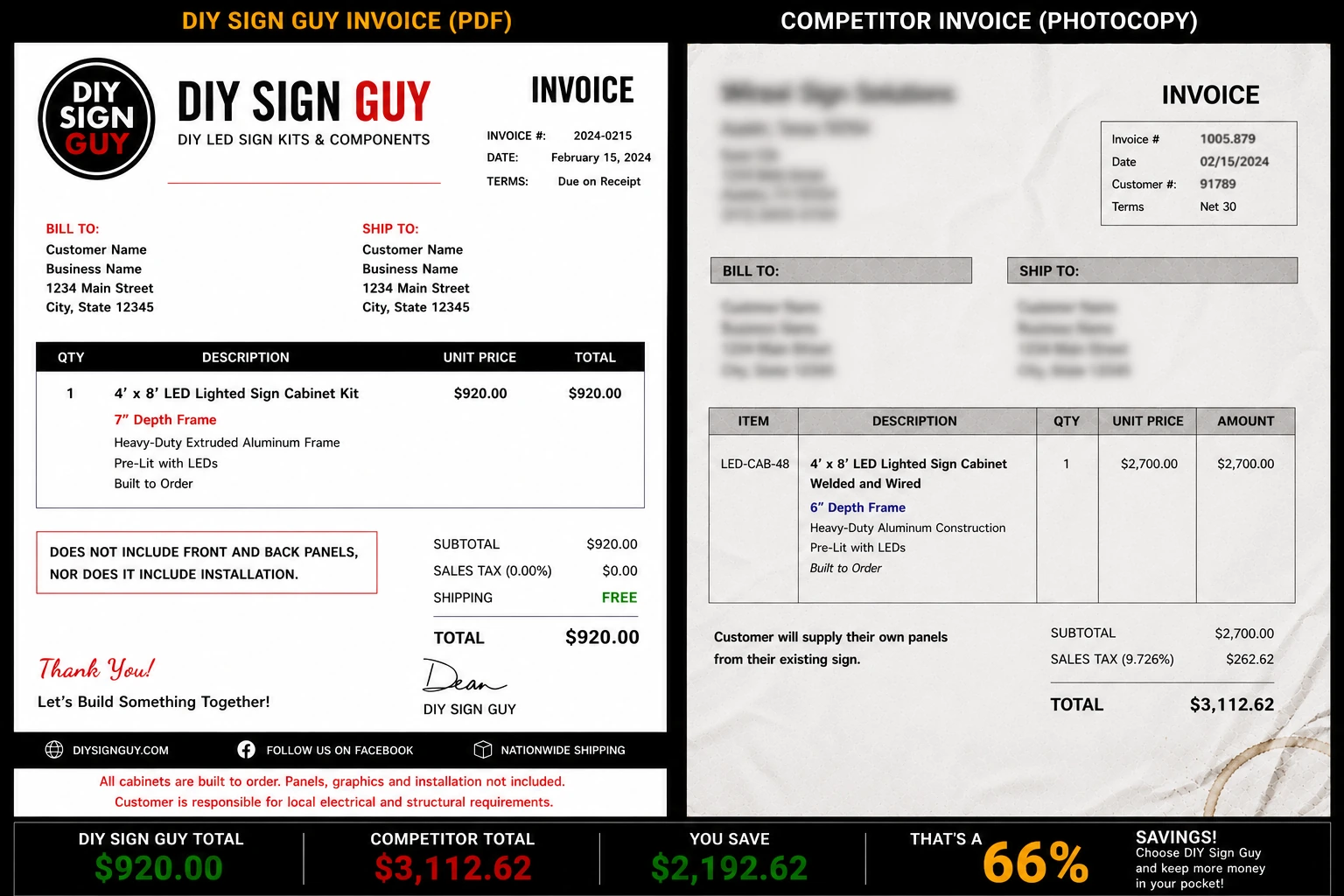
| 4′ × 8′ lighted sign example* | $3,112 | $984 kit + your installation |
| Permits & inspections | Usually handled for you | You check with your township — we help plan a cabinet that fits the rules |
| Best fit | Complex installs, no time to coordinate | Owners and contractors comfortable with bolts, a level, and an electrician for hookup |
* Example comparison based on the specifications shown on our pricing page. Savings are potential, not guaranteed; prices subject to change.
Lighted business sign kit pricing shipped to Aurora
| Frame depth | Price per foot of frame length | Typical use |
|---|---|---|
| 4-inch — most popular | $41 per foot | Wall-mounted storefront signs |
| 7-inch | $47 per foot | Wall installs and double-pole signs |
| 10-inch | $67 per foot | Pylon and single-pole roadside signs |
Every kit is pre-lit with a 12-volt power supply included as quoted. Sign faces and graphics are separate. Prices subject to change without notice — get your written quote.
Straight Answers For Aurora Businesses
My address is in Arapahoe County but the city is Aurora — who do I call?
Call the City of Aurora first. Home rule cities generally handle their own sign review no matter which county the parcel falls in, and Aurora covers parts of Arapahoe, Adams and Douglas. The county still matters for records and for anything the city does not administer. If your address turns out to be outside city limits entirely, the county takes over.
Single-sided or double-sided?
The same welded frame handles either, so it is a decision about the road rather than about the product. A cabinet read from one approach only does not need a second face. A monument at a corner, or a sign on a divided road with traffic coming both ways, usually earns one. Tell us which you want when you request the quote, since it changes the build.
Do I need a permit for a lighted sign in Aurora?
Assume yes, and start with the City of Aurora. Expect the sign permit plus a separate electrical permit for an illuminated cabinet, and expect setback and height standards to depend on your zone and your street frontage. Whatever number comes back approved is the number we weld to, so get it in writing before the order goes in rather than after the frame is already cut.
Who handles the electrical connection?
Hire a licensed electrician for it. These kits are not UL listed, and the hookup is permitted and inspected work in Colorado regardless of how simple it looks from the ground. Everything mechanical is yours: the sections, the bolts, the mounting. Line the electrician up while the cabinet is being built so you are not sitting on a finished sign waiting for a callback.
How much does a lighted business sign cost in Aurora?
Less than most owners expect — because you skip the full-service labor. Our aluminum LED sign cabinet kits run $41 per foot of frame length in the 4-inch depth, $47 for 7-inch and $67 for 10-inch, pre-lit with the power supply included as quoted. As an example comparison, a 4' x 8' lighted sign quoted at $3,112 by a full-service company runs about $984 as a kit — savings are potential, not guaranteed. Sign faces and graphics are separate, prices are subject to change, and every kit is quoted in writing to your exact size.
Do you install signs in Aurora?
No — we are not an Aurora sign installation company, and that is exactly why the price works. We build and ship the lighted cabinet; you or a local contractor handle the mounting, with a qualified electrician for the electrical hookup. Real guidance from the builder comes with every kit, and your local township sets the permit and inspection rules.
Do you sell programmable LED message center signs in Aurora?
Yes. An LED message center — also called an electronic message center, an EMC, a programmable LED sign, an LED message board or a digital marquee — is an outdoor display built into a sign that you change yourself from a phone, tablet or computer. It ships to Aurora the same way our lighted cabinets do, and it is quoted in writing to your size. Many towns regulate message centers separately from static signs, so confirm brightness, hold time and animation rules with your local township before ordering. Easy financing available — ask when you request your quote.
What is the difference between a lighted cabinet sign and an LED message center?
A lighted cabinet sign shows one fixed printed face and lights it from behind — it carries your business name permanently. An LED message center shows changeable messages you update whenever you want. Most businesses run both on the same structure: the cabinet on top for the name and logo, the message center below it for today's special, price or hours.
What is an illuminated cabinet sign?
An illuminated cabinet sign — also called a light box sign — is an aluminum box with lighting inside and translucent faces: the classic lighted sign above a storefront. Ours ships as a prepared kit with the frame cut to your exact size, LEDs already mounted inside, and a 12-volt power supply included as quoted.
Answers by Dean, the DIY Sign Guy — building signs since 2004.
Get A Written Price For Aurora, CO
Tell me what you need and I’ll send you a straight, written quote — from the guy who actually builds it. No showroom visit, no pressure.